
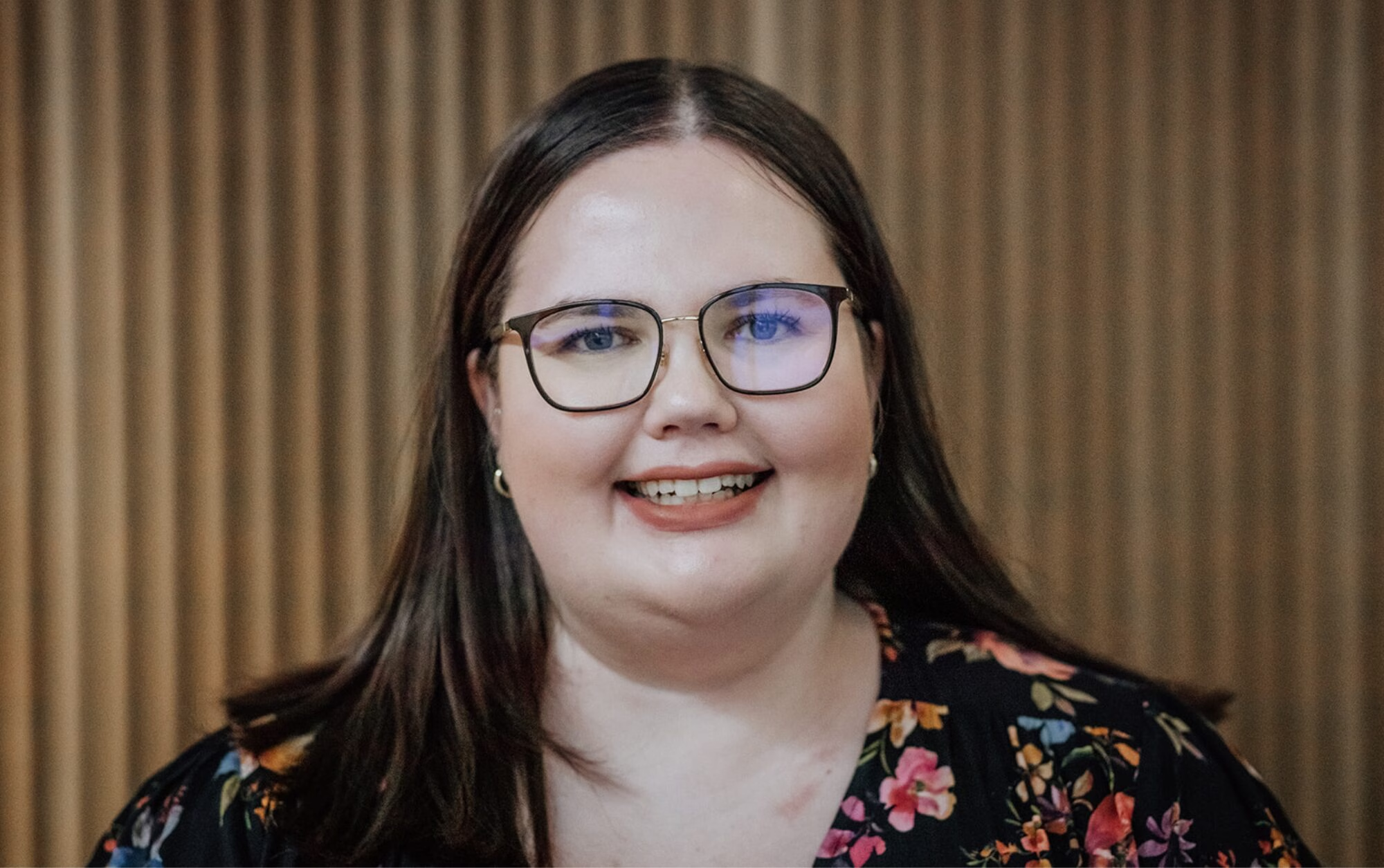
Dr Ella Smalley is a Research Fellow at the Menzies Institute for Medical Research in Hobart, Tasmania. She is supervised by Professor Joanne Dickinson.
Connect with Ella on LinkedIn.
Tell us a bit about yourself and how you got interested in pulmonary fibrosis research.
My research has consistently focused on understanding the molecular mechanisms underlying lung disease. During my PhD, I investigated how suboptimal mechanical ventilation can exacerbate existing lung injury or induce damage in an otherwise healthy mouse model. In particular, I explored how stressed lung cells release signalling molecules that drive a self-perpetuating cycle of injury and inflammation.
The experimental frameworks I developed during this work translated naturally into pulmonary fibrosis research, where the underlying molecular mechanisms remain incompletely understood. This has motivated my continued focus on identifying the pathways that initiate and drive disease progression.
How would you explain your pulmonary fibrosis research to someone unfamiliar with the field?
I am a basic scientist, meaning my research focuses on understanding disease at a molecular and cellular level, with the aim of identifying pathways that could be targeted therapeutically.
I am involved in the Genetic Research in Pulmonary Fibrosis (GRIPF) study, which investigates families with clustering of disease to identify genetic variants that may contribute to pulmonary fibrosis. To model these variants, I use induced pluripotent stem cells (iPSCs), which can be directed to differentiate into specialised cell types.
Using gene editing approaches, we introduce prioritised genetic variants identified in patients into stem cell lines. These cells are then differentiated into alveolar epithelial type 2 (AT2) cells—the key cell population affected in pulmonary fibrosis. This allows us to directly assess how specific genetic variants influence cell behaviour and contribute to disease mechanisms.
Why is this work important?
A critical first step in developing effective therapies is understanding how disease is initiated and progresses. In pulmonary fibrosis, the mechanisms that drive the transition from a healthy lung cell to a fibrotic phenotype remain largely unknown.
The GRIPF study aims to address this gap by identifying genetic contributors to disease onset and progression. Importantly, different genetic variants may influence how patients respond to treatment, which has significant implications for personalised medicine and improving clinical outcomes.
What are the best bits about working in this area?
One of the most rewarding aspects of working in pulmonary fibrosis research is being part of a highly collaborative and translational research environment. Within networks such as CRE-PF, there is a strong collective commitment to improving patient outcomes, which creates a supportive and purpose-driven research culture.
There are also excellent opportunities for career development, including access to funding, mentorship, and collaborative projects. I am particularly grateful to have been awarded the Hope Fellowship this year, which provides invaluable support for advancing my research.
What are some of your biggest achievements to date?
Completing my PhD is one of my most significant achievements, representing a sustained and challenging effort over several years.
In addition, I have been actively involved in consumer and community engagement initiatives. This work was recognised through my selection as the 2024 Tasmanian Young Achiever of the Year, followed by being named a state finalist for the 2025 Young Australian of the Year. These experiences have been incredibly inspiring, particularly in highlighting the impact of young leaders working to improve healthcare outcomes.
What advice would you offer ECRs just starting out in the field?
My advice to early career researchers is to be proactive in building connections and not be afraid to take risks. Introducing yourself to researchers whose work you admire and seeking out collaborative opportunities early can be incredibly valuable.
Some of the most insightful ideas come from informal discussions—particularly at conferences—where exposure to different perspectives can help shape your own research direction. Developing this kind of critical thinking and openness early in your career can have a lasting impact.
Where do you hope to see yourself in your career in the next 5 years? Are there any shifts you would like to see in in field during that time?
In the next five years, I hope to continue building on my work developing stem cell–based models of pulmonary fibrosis, with a focus on refining iPSC-derived systems to more accurately capture disease biology. By combining these models with gene editing technologies, I aim to better understand how specific genetic variants influence cell function and contribute to disease progression.
More broadly, I would like to see the field continue to adopt and optimise these types of human-relevant models, alongside stronger integration with clinical and genomic data. This will be key to enabling more precise, mechanism-based approaches to treatment.